







Supplementation with the natural substance ursolic acid may protect brain axons across generations
The effects of diet can be far-reaching and not even limited to yourself, but most research has focused on the effects of a mother's diet on obesity and metabolic disease in her offspring.
Recently, in the journal Nature Cell Biology, a team of researchers led by Professor Roger Pocock from Monash University, with Dr Wenyue Wang as first author, published a study showing the axonoprotective effects of a mother's diet on her offspring and even her offspring's offspring.
Using the Hidradenitis elegans cryptic roundworm model, they found that maternal ursolic acid supplementation improved axonal transport and reduced axonal breakage in two generations of offspring, and identified the mechanism and key mediator, a sphingolipid called sphingosine-1-phosphate.
Ursolic acid is a triterpenoid compound found in natural plants, with sedative, anti-inflammatory, antibacterial, anti-diabetic, anti-ulcer, hypoglycemic and other biological effects, ursolic acid also has obvious Antioxidant function, so it is widely used as a raw material for medicine and cosmetics.
Ursolic acid has been clinically shown to significantly and rapidly reduce ghrelin and serum aminotransferase, reduce gangrene, increase appetite, inhibit fibrosis and restore liver function, with fast action, short treatment time and stable effect.
Axons are very important for maintaining healthy neurons, substances such as proteins and lipids need to be transported by axons, and the microtubules in them are one of the key mechanisms that allow axonal transport and movement of the transported substances, which become progressively weaker with age, and this is one of the causes of brain dysfunction and neurodegeneration.
The team wanted to find natural substances that protect axons from breaking with age, and during the screening process they targeted ursolic acid, a substance found in apples and herbs such as basil, rosemary and thyme that inhibits axon fragility.Supplementation of the nematode mothers resulted in a significant reduction in axon breakage of posterior lateral mechanosensory (PLM) neurons in the offspring, with a period of efficacy during the period of egg production and maturation, and the protection of the offspring axons can span two generations.
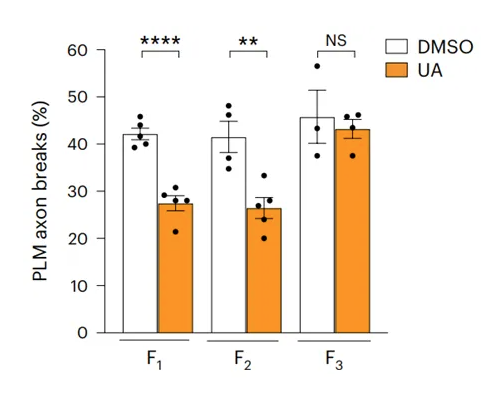
Ursolic acid (UA) supplementation in nematode mothers resulted in significantly fewer neuronal axon breaks in two generations of offspring (F1 and F2).
Having established the protective effects of ursolic acid, the next step was to understand the mechanisms involved.
Since the period of action is during oocyte production and maturation, the researchers speculated that ursolic acid might affect the supply of yolk to the oocytes. Yolk synthesised in the nematode gut contains lipids and lipoproteins that provide nutrients for oocyte and embryo development, and oocyte uptake of yolk via endocytosis requires RME-2 receptor-mediated uptake, and the researchers found that RME-2 is required for ursolic acid to reduce neuronal vulnerability and provide the necessary support for gut-oocyte transport.
In terms of specific functional performance, ursolic acid and S1P facilitated protein transport along axons in the presence of axonal microtubule instability due to genetic factors, and ursolic acid and S1P reduced axon breakage even when chemical effects continued to be exerted on top of the genetic factors, i.e. even in the presence of the two vulnerability factors, ursolic acid and S1P robustly reduced axon vulnerability.
Furthermore, this protective effect on axons was generalised, with ursolic acid and S1P reducing axon breakage in several genetic models, as well as in D-type GABAergic motor neurons and PVQ interneurons.
Further investigation showed that S1P has a regulatory role in intergenerational inheritance by increasing transcription of the asah-1 gene in the gut.
This means that protective molecules produced by nematode mothers supplemented with the natural compound ursolic acid can be transported from the gut to the oocyte to improve axonal vulnerability in two generations of offspring, and this protective effect is universal, acting across genetic factors and neuron types.